

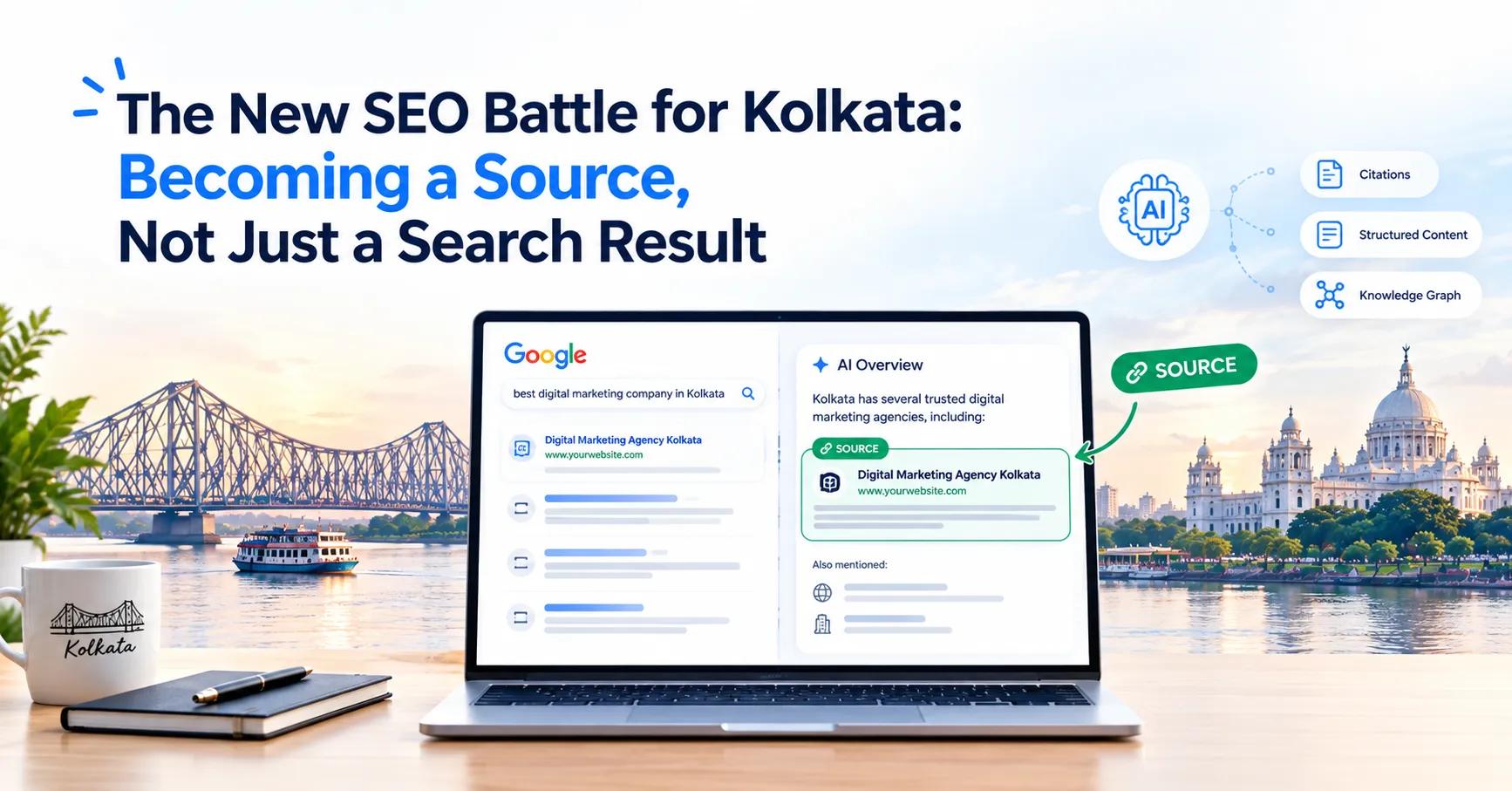
The New SEO Battle for Kolkata: Becoming a Source, Not Just a Search Result
For years, the goal of SEO was straightforward: get your business onto Google's first page, ideally near the top.
That goal still matters. But search is changing.
Google now has AI Overviews and AI Mode, while other AI-powered search experiences can answer questions by retrieving information from multiple websites and presenting a synthesized response with source links. Google says its AI search systems can use “query fan-out,” breaking a complex question into related searches to find supporting information across the web.
For Kolkata businesses, this creates a new SEO challenge.
It is no longer enough to be a search result. Your business needs to become a credible source that AI systems can understand, verify and confidently reference.
Why ranking alone is becoming less predictable
Imagine someone searches:
“Which digital marketing agencies in Kolkata are experienced with AI search optimization?”
In traditional search, the user receives a list of pages.
In an AI-powered search experience, the system may instead combine information from business websites, directories, reviews, publications and other sources before producing a shortlist.
That changes the competitive question.
Instead of asking only, “How do I rank for this keyword?”, businesses increasingly need to ask:
“Does the web contain enough consistent evidence for an AI system to understand what my business is, what it does and why it is relevant?”
Google's own guidance is important here: there is no special technical requirement or separate secret optimization needed for AI Overviews or AI Mode. The fundamental foundations of SEO still apply, including technical accessibility and helpful, reliable, people-first content.
The difference is how those foundations are being used.
The emerging concept: source authority
Traditional SEO largely revolves around relevance, quality, authority and search intent.
AI search adds another practical dimension: sourceability.
A sourceable business has information that is:
Clearly written
Easy to retrieve
Specific about its services and location
Supported by credible evidence
Consistent across the web
Useful in answering real customer questions
For a Kolkata company, that might mean clearly explaining its services, industries, locations served, expertise and differentiators rather than filling pages with repetitive keywords.
The objective is not to “write for AI.”
It is to make the business so clear and well-supported that both people and information-retrieval systems can understand it.
Kolkata businesses have a particular opportunity
Local search makes this shift especially interesting.
A customer rarely asks an AI system only for a generic definition. They may ask:
“Who are reliable website development companies in Kolkata?”
“Which SEO agencies in Kolkata understand AI search?”
“Which digital marketing company can help a local business improve online visibility?”
These are entity-and-context questions.
The answer may depend on several signals rather than one webpage.
A 2026 BrightLocal study examining almost two million local AI citations found that AI systems drew information from a very large range of domains, including Google Business Profiles, business websites, directories, social platforms and specialist sources.
That means local visibility is becoming less dependent on one isolated ranking position.
Your entire digital footprint matters.
Five things that can turn a business into a source
1. Make your business entity unmistakably clear
Your website should make basic facts easy to understand.
Who are you?
What do you offer?
Where do you operate?
Who do you serve?
What industries do you understand?
What makes your approach different?
For a Kolkata business, geographic relevance should not be hidden inside metadata. It should appear naturally throughout useful content, service explanations and business information.
The goal is to remove ambiguity.
2. Create answers, not keyword-filled pages
AI search is designed to answer questions.
Your website should therefore contain useful answers to the questions your customers actually ask.
Instead of producing another generic page targeting “AI SEO Kolkata,” consider answering questions such as:
How does AI search differ from traditional Google search?
Can a local business appear in AI-generated answers?
What information does an AI system need to understand a business?
Why do third-party mentions matter for local visibility?
Each answer creates a potentially useful information unit.
Google has specifically warned against producing large amounts of AI-generated content without meaningful value. Its guidance emphasizes original, useful content rather than scaled pages created primarily to manipulate search or generative AI visibility.
3. Build corroboration beyond your website
A business cannot completely control what the rest of the internet says about it.
That is actually important.
Independent mentions can help establish context.
Industry publications, reputable directories, professional profiles, reviews and relevant community discussions can all contribute to how a business is represented online.
Current local-AI research supports this broader view. BrightLocal found that AI systems use many different external sources when answering local-business questions, while another 2026 study found business websites accounted for nearly 60% of Gemini's local AI citations in its particular dataset.
These findings should not be treated as a universal ranking formula. They do show something strategically important:
AI visibility is increasingly a web-wide reputation problem, not simply an on-page SEO problem.
4. Make important information citable
A strong article does not force an AI system to interpret everything from a 2,000-word paragraph.
Important claims should be clear.
Definitions should be direct.
Numbers should have dates and sources.
Service descriptions should be specific.
Statements about experience should be supported where appropriate.
For example:
“AI search optimization helps businesses improve how their information can be discovered, understood and referenced by AI-powered search systems.”
That is clearer and more extractable than a paragraph filled with abstract marketing language.
This also benefits human readers.
5. Think beyond Google
Google is central, but AI-powered discovery is not limited to one interface.
ChatGPT can search the web and provide citations to sources.
Microsoft's AI search experiences can also use web information and references when generating answers.
The practical lesson is not to create a separate page for every AI platform.
It is to build a consistent, trustworthy information ecosystem that different retrieval systems can understand.
Where traditional SEO still fits
The phrase “SEO is dead” misses the point.
Google explicitly says that its AI search experiences are rooted in existing Search systems and that the fundamental SEO best practices remain relevant. A page still needs to be accessible, indexable and useful before it can become a supporting source.
So the better model is:
Traditional SEO gets your information into the searchable ecosystem.
AI-oriented optimization makes that information easier to interpret, connect and cite.
For businesses evaluating an AI SEO Company Kolkata, the important question should therefore not be whether an agency promises “AI rankings.”
Ask instead whether its strategy improves technical SEO, topical authority, entity clarity, useful content, local signals and the broader evidence surrounding the business.
The new competitive advantage: being the business AI can explain
Consider two Kolkata companies.
Company A has a technically optimized website and ranks reasonably well for several keywords.
Company B also has good SEO, but its website clearly explains its services, publishes useful original material, maintains consistent business information, earns relevant third-party mentions and answers detailed customer questions.
Company B gives an AI system more context to work with.
That does not guarantee a citation or recommendation. AI search results can change between queries, locations and platforms.
But it creates a stronger information foundation.
And that foundation is likely to become increasingly important as search moves from retrieving pages toward constructing answers.
For businesses looking beyond SEO alone, an AI Digital Marketing Agency can help connect these activities across content, search, reputation and digital channels rather than treating each one as an isolated tactic.
What Kolkata businesses should do now
Start with five practical questions:
Can a stranger understand exactly what our business does within 30 seconds?
Does our website answer the questions customers actually ask?
Are our business details consistent across important external sources?
Do independent websites reinforce our expertise and relevance?
Could an AI system confidently explain why our company belongs in an answer about our category and location?
If the answer to several of these is “no,” another batch of keyword-focused pages is probably not the first priority.
Strengthen the underlying evidence first.
The real SEO battle has changed
The next stage of local SEO is unlikely to be about abandoning rankings.
It is about going beyond them.
A first-page position can put a business in front of a searcher. A strong source footprint can help an AI system understand the business, connect it with a customer's question and potentially reference it while constructing an answer.
That is the strategic shift Kolkata businesses should prepare for.
Don't aim only to be the result someone clicks. Build a business presence that can become the source an answer is built from.
Key Takeaways
Traditional SEO remains important for AI search visibility.
AI search can retrieve and combine information from multiple sources.
Local businesses should strengthen both their own website and external corroborating signals.
Clear, useful and evidence-backed information is more valuable than keyword-heavy content.
Kolkata businesses should treat AI visibility as a broader digital-authority challenge, not simply another ranking position.