

Building a Better Digital Presence Without Losing the Human Side of Business
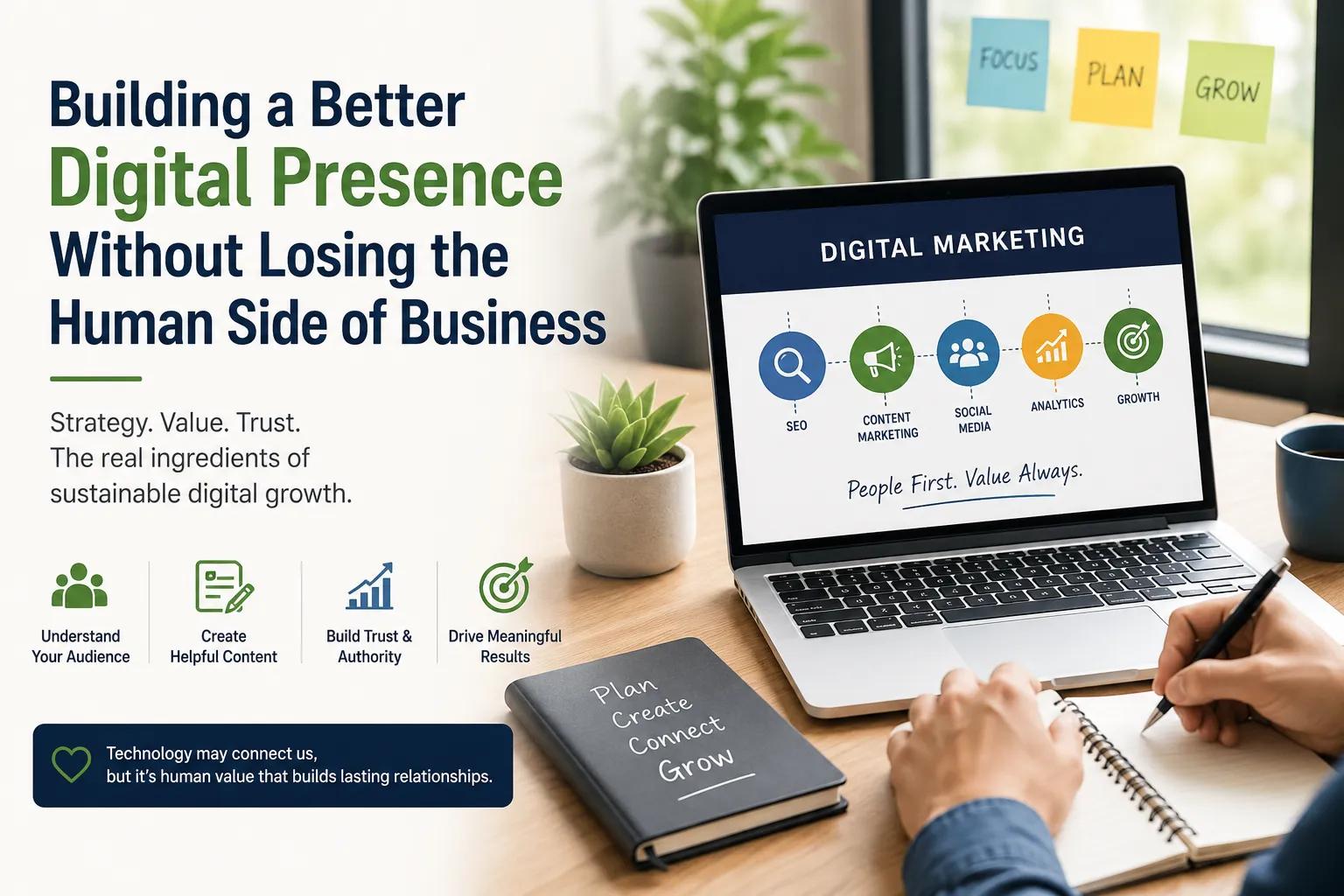
The internet has changed the way we work, communicate, discover businesses, and make decisions.
Today, a small business can reach someone thousands of kilometres away with a single piece of useful content. A professional can build a reputation without having a large office. A new company can compete with established brands if it knows how to communicate its value clearly.
That is exciting.
But there is another side to this digital transformation.
Many businesses have become so focused on being visible online that they have forgotten something more important: being valuable to the people they are trying to reach.
Posting every day does not automatically create trust.
Having thousands of followers does not automatically create customers.
Running advertisements does not automatically create meaningful growth.
A strong digital presence begins with something much simpler: understanding people.
The Difference Between Being Visible and Being Valuable
Imagine two businesses.
The first one posts several times a week. Every post is filled with promotional messages, discounts, offers, and calls to buy.
The second business posts less frequently, but its content answers questions, explains problems, shares useful ideas, and helps people make better decisions.
Which business would you remember?
Probably the second one.
This is because people rarely connect with a business simply because it is visible. They connect when they feel that the business understands their needs.
That is where digital marketing becomes more than advertising.
It becomes communication.
A Website Is More Than an Online Address
A website is often the first serious interaction someone has with a business.
Before making a purchase, contacting a company, or booking a service, people may look at its website to understand:
What does this business do?
Can I trust it?
Does it understand my problem?
Is there enough information to help me make a decision?
A well-designed website should therefore do more than look attractive. It should make the visitor feel informed and comfortable.
The same principle applies to search engine optimization.
SEO is often discussed in terms of rankings and keywords, but at its heart, good SEO is about helping people find useful information at the moment they need it.
When a business creates genuinely helpful content, optimizes its website properly, and answers real customer questions, search visibility becomes a natural result of providing value.
Digital Marketing Should Not Feel Like a Lottery
One of the biggest challenges businesses face is inconsistency.
One month, an advertisement performs extremely well.
The next month, the same campaign struggles.
One social media post gets thousands of views.
Another receives almost no engagement.
This can make digital marketing feel unpredictable.
But sustainable marketing should not depend entirely on luck.
A good strategy looks at the complete journey.
Someone first discovers the brand.
Then they become curious.
They visit the website.
They consume content.
They begin to trust the business.
Eventually, they take action.
This journey takes time, and every stage has a purpose.
That is why businesses should think beyond individual posts or advertisements and start thinking about the complete customer experience.
Learning From Different Approaches
There are several professionals and digital marketing organizations whose online presence demonstrates different aspects of this approach.
Digital Piloto
Digital Piloto is an example of a performance-focused digital marketing approach where marketing is connected to measurable business objectives.
Instead of looking at digital activity as an end in itself, the bigger question is what that activity is expected to achieve.
SEO, paid advertising, content, social media, and conversion-focused activities can all play different roles in a growth strategy.
The important lesson for businesses is not simply to use more marketing channels.
It is to understand why each channel exists and how it contributes to the larger business objective.
When strategy comes before activity, marketing becomes easier to evaluate and improve.
Amlan Maiti
Amlan Maiti provides an interesting example of how SEO expertise and personal branding can work together.
In a crowded digital environment, people increasingly want to know the person or expertise behind a brand.
Personal branding can help professionals communicate what they know, what they stand for, and how they can help others.
SEO adds another layer by making that expertise easier to discover through search.
The bigger lesson is that digital authority is rarely created overnight.
It develops through useful content, consistency, expertise, and trust.
Every helpful article, meaningful insight, and genuine interaction can become another small building block in that process.
Sanjay Dhar
Sanjay Dhar represents another perspective worth considering: the importance of experience and strategic thinking in digital marketing.
Marketing trends change constantly.
Platforms change.
Algorithms change.
Consumer behaviour changes.
What remains valuable is the ability to understand the fundamentals behind those changes.
A sustainable digital strategy should therefore not depend entirely on a particular trend or platform.
It should be flexible enough to adapt while remaining focused on the business's core goals.
That is one of the biggest differences between chasing a trend and building a long-term digital presence.
The Human Side of Digital Marketing
Technology gives businesses incredible opportunities.
But technology alone cannot create meaningful relationships.
People still want clear communication.
They want honest answers.
They want businesses to understand their problems.
They want to feel confident before spending their money.
This is why authenticity matters.
A business does not need to pretend to be perfect.
Sometimes explaining a challenge, sharing a lesson, answering a difficult question, or showing the people behind the business can create more trust than another perfectly designed promotional graphic.
The best digital presence often feels human.
Five Simple Questions Every Business Should Ask
Before publishing another post or spending money on another campaign, ask:
1. Who am I trying to help?
If the audience is unclear, the message will probably be unclear too.
2. What problem am I solving?
People are usually more interested in solutions than advertisements.
3. Why should someone trust me?
Experience, useful information, transparency, reviews, case studies, and consistency can all contribute to trust.
4. What should someone do after discovering my brand?
Every customer journey needs a logical next step.
5. Am I measuring meaningful outcomes?
Likes and impressions can provide useful signals, but businesses should also understand enquiries, qualified leads, conversions, customer retention, and revenue.
These questions can completely change how a business approaches digital marketing.
Growth Does Not Have to Mean Doing More
There is a common belief that successful digital marketing requires constant activity.
More posts.
More reels.
More advertisements.
More platforms.
More content.
But sometimes the better answer is the opposite.
Do less, but do it better.
Create content that answers real questions.
Improve the pages that matter most.
Understand the audience more deeply.
Build a consistent brand message.
Measure what actually matters.
Then improve the process over time.
That approach may not feel as exciting as chasing every new trend, but it can create something far more valuable: a digital presence that compounds.
A Positive Way to Think About Digital Growth
Digital marketing does not have to be about constantly competing for attention.
It can be about creating value.
A helpful article can save someone hours of research.
A clear website can help someone make a confident decision.
An informative social media post can teach something useful.
A thoughtful brand can make a customer's experience easier.
When businesses approach digital marketing from that perspective, marketing becomes more meaningful.
The goal is no longer simply:
“How can I get more attention?”
The better question becomes:
“How can I use digital channels to become more useful to the people I want to serve?”
That small change in perspective can lead to better content, better communication, better customer experiences, and ultimately, better business outcomes.
Final Thoughts
The future of digital marketing will not belong only to the businesses that publish the most content.
It will belong to the businesses that understand their audience, communicate clearly, provide genuine value, and consistently earn trust.
Technology gives us the tools.
Strategy gives those tools direction.
But people give marketing its purpose.
So before planning the next campaign, creating the next post, or spending the next marketing budget, take a step back.
Ask yourself:
Am I simply trying to be seen, or am I actually trying to be useful?
That question may be the beginning of a much better digital strategy.